Cache-to-Cache
Direct semantic communication between LLMs through KV cache projection and fusion, with higher accuracy and lower latency than text-based communication.
Overview
LLMs communicating beyond text
Multi-LLM systems combine diverse models to leverage their complementary strengths. But current text-based communication creates bottlenecks.

Motivation
Why communicate beyond text?
Text-based communication between LLMs has fundamental limitations
Information Bottleneck
High-dimensional semantic representations are compressed into linear text sequences
Ambiguity
Natural language is inherently vague and can be misinterpreted by the receiver
Latency
Slow token-by-token generation is required for every communication exchange
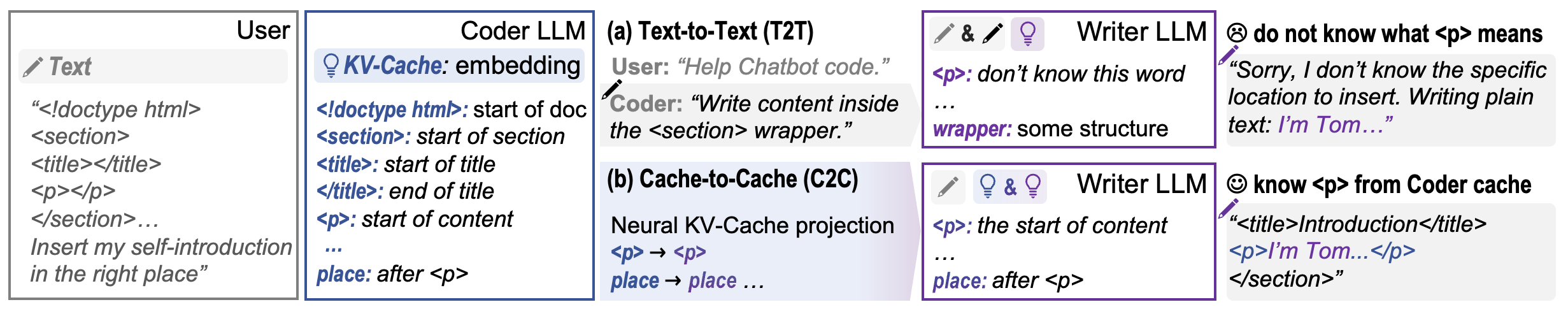
Example: Text-to-Text communication loses structural semantics through ambiguous descriptions. Cache-to-Cache transfers precise semantic understanding directly.
The Discovery
KV Cache carries semantic meaning.
Oracle experiments reveal three key findings that motivate Cache-to-Cache communication.
Oracle 1: Cache Enrichment
Question: Can enriched KV cache improve response quality without increasing cache size?
Does few-shot prompting improve accuracy by attending to more tokens, or by enriching how the question is embedded in KV cache? We test this by prefilling on exemplars E⊕X, then discarding E and keeping only the question-aligned cache slice.
- Direct: 58.42% accuracy (cache length |X|)
- Few-shot: 63.39% accuracy (cache length |E| + |X|)
- Oracle: 62.34% accuracy (cache length |X| only)
Finding: The gain comes from richer question embeddings, not from attending to extra tokens. KV cache can carry enriched semantics.
Oracle 2: Cache Transformation
Question: Can one model's KV cache be utilized by another model?
We trained a 3-layer MLP to map KV cache from Qwen3-4B (source) to Qwen3-0.6B (target). T-SNE visualization shows the transformed cache moves into the target model's representation space.
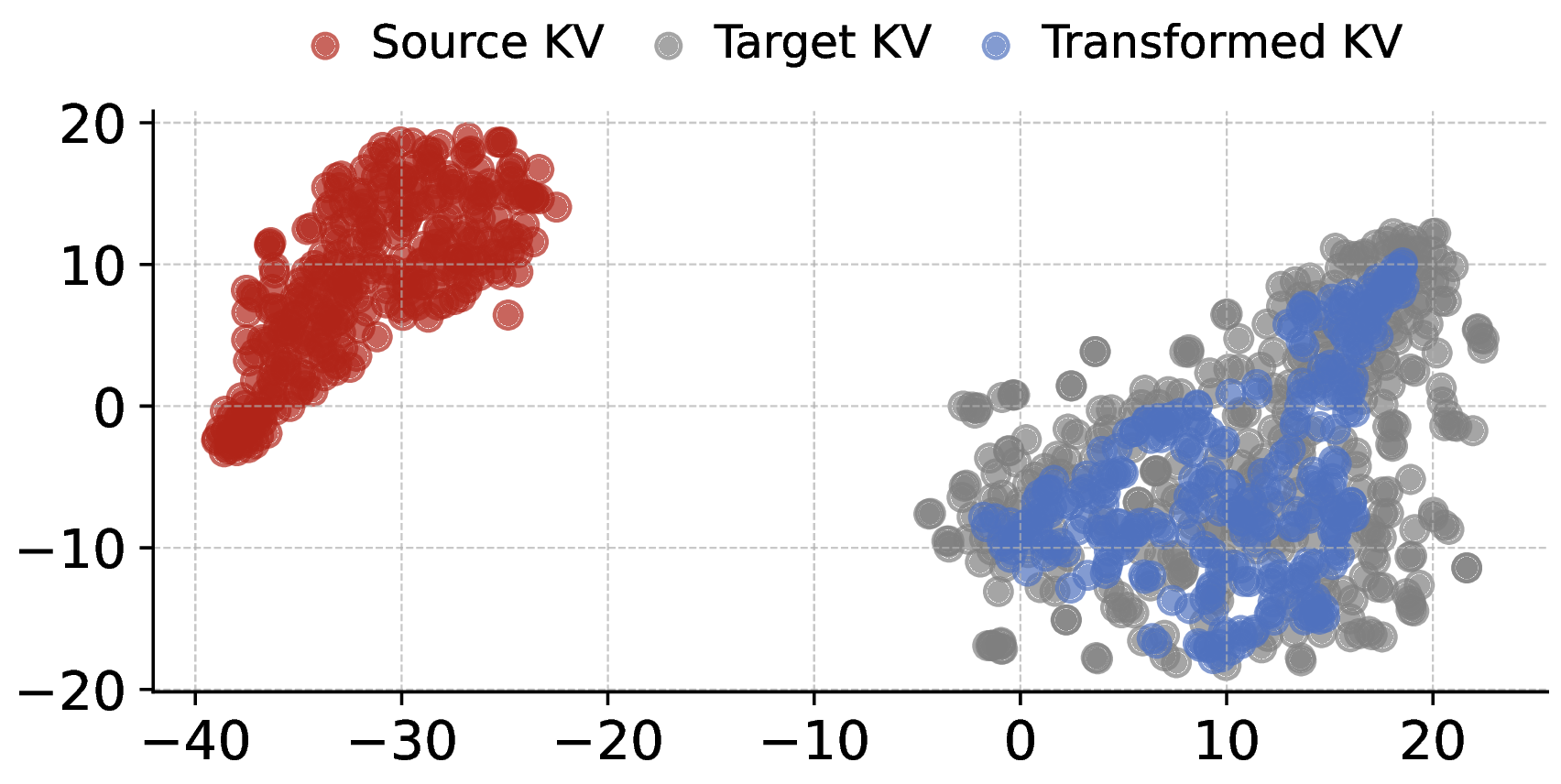
Finding: The transformed cache occupies a subset of the target's space, reflecting distinct semantic understandings across models. This suggests fusing specialized contextual understanding from different models could harness their complementary strengths.
Architecture
Cache-to-Cache Fuser

C2C Fuser: Projects and combines both models’ KV caches, then adds the result to the Receiver’s cache through a learnable gate.
Projection Module
Concatenates and processes KV caches from both models through projection and feature fusion layers
Dynamic Weighting
Input-aware head modulation layer for adaptive information flow between models
Learnable Gating
Trainable per-layer gates control fusion; input-aware weights modulate how much information is added.
Training: Freeze both models, train only C2C module with next-token prediction loss
Experiments
Benchmark Results
Qwen3-0.6B Receiver with three Sharers across four benchmarks.
Headline metrics: Qwen3-0.6B Receiver · Qwen2.5-0.5B Sharer · four-benchmark average (Table 4).
Accuracy gains are percentage-point differences. Speedup is mean T2T latency divided by mean C2C latency over the selected rows. Single A100, batch size 1; paper Table 4.
View Detailed Results
| Receiver | Sharer | Benchmark | Receiver Only | Sharer Only | Routing | Text-to-Text | Cache-to-Cache |
|---|
Summary
Key Contributions
Novel Paradigm
Direct semantic communication through learned KV cache projection and residual fusion.
Effective & Efficient
With Qwen2.5-0.5B as Sharer, C2C improves Qwen3-0.6B accuracy by 11.0 percentage points and cuts T2T latency by a factor of 3.46, averaged across four benchmarks.
Flexible & General
Supports different model families, sizes, and specializations through trained fusers with token and layer alignment.
Citation
Cite our work.
If you find C2C useful for your research, please consider citing our paper.
@article{fu2025c2c,
  title={Cache-to-Cache: Direct Semantic Communication Between Large Language Models},
  author={Fu, Tianyu and Min, Zihan and Zhang, Hanling and Yan, Jichao and Dai, Guohao and Ouyang, Wanli and Wang, Yu},
  journal={arXiv preprint arXiv:2510.03215},
  year={2025}
}