Roads to Rome
Token-level routing between small and large reasoning models. R2R learns which tokens need the large model, leaving most generation to the small one.
The Challenge
LLMs are powerful but expensive.
Small models are fast but make mistakes. What if we could get the best of both worlds?
Small Models (1.5B)
Fast generation
Limited accuracy
R2R Routing
Best of both worlds
Smart token routing
Large Models (32B)
Accurate reasoning
Slow & expensive
The Discovery
Not all tokens are equal.
In the 7.6M-token routing training set, R1-1.5B and R1-32B agree on most next-token predictions under the same context. Only about 5% of tokens are labeled path-divergent.
Interactive Demo
Watch R2R in action.
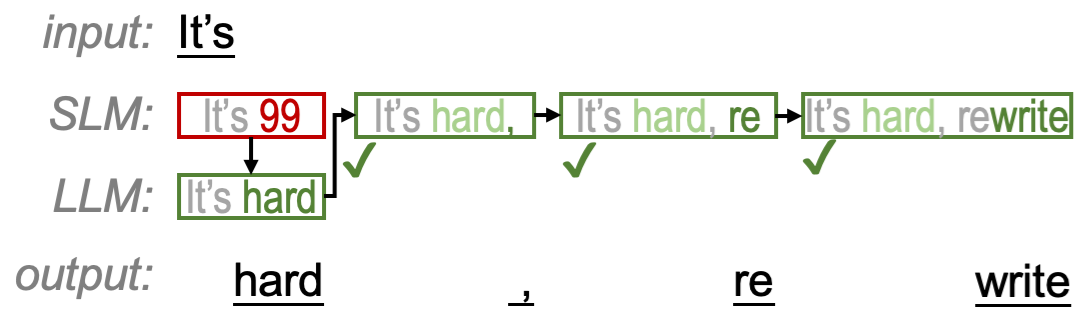
An animated example of token-level routing. The preset continuations illustrate offline labeling, rather than live model output.
Continuation comparisons illustrate the neutral and divergent labels.
Watch Video Demo
Side-by-side comparison: R1-32B (left) vs R2R (right). Red tokens are routed to LLM.
How It Works
Intelligent token routing.
R2R uses a lightweight neural router trained on automatically generated token-level labels to decide which tokens need the large model's attention.
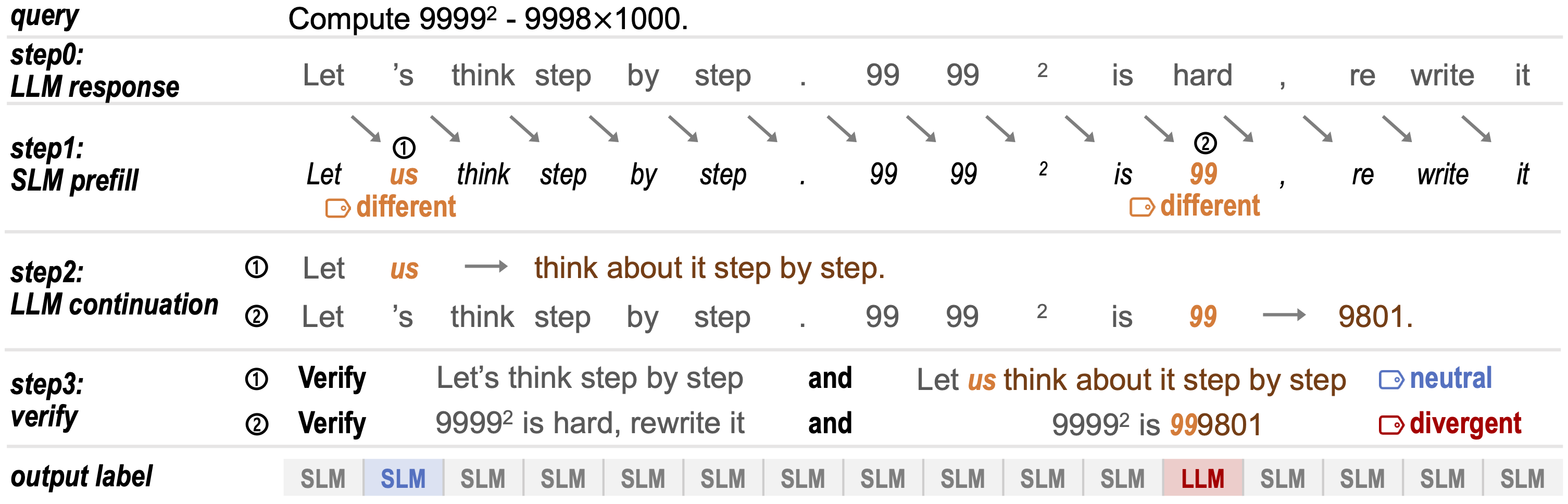
Automatic Data Generation Pipeline
A key contribution of R2R is an automatic pipeline for generating token-level routing labels without expensive human annotation:
- LLM generates the reference response.
- SLM prefills that response to find differing next-token predictions.
- LLM continues each differing SLM token to the sentence boundary; the reference continuation comes from the original response.
- Verifier model compares the sentence continuations to label neutral or divergent differences.
This pipeline produces large-scale training data automatically, enabling the router to learn which token differences actually matter for reasoning.
Path-Following Routing Strategy
When generating routing labels, we compare the next-token predictions of the SLM and LLM. Identical predictions can use the SLM output. For differing predictions, continuation and verification determine whether the difference is:
- Neutral: Doesn't affect reasoning outcomes (use SLM)
- Divergent: Alters the reasoning path (route to LLM)
Sentence-level verification provides offline training labels. During inference, the neural router predicts divergence from SLM features and invokes the LLM when its score exceeds a threshold. It approximates the labeling strategy rather than verifying every continuation.
Neural Router Architecture
The router is a lightweight 56M-parameter feed-forward network that takes three inputs from the SLM:
- Top-100 SLM logits: Captures prediction uncertainty (higher entropy indicates potential divergence)
- Token embeddings: Encodes token frequency biases (rare tokens are more likely to diverge)
- Last-layer hidden states: Provides semantic context for the current generation step
A divergence score enables immediate routing decisions. Adjusting the threshold changes LLM usage without retraining; the reported configuration uses the LLM for 11–15% of tokens.
Predictive Indicators of Divergence
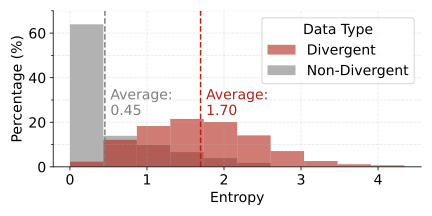
SLM Entropy
Average SLM output entropy is 3.8× as high for divergent tokens as for non-divergent tokens, indicating greater prediction uncertainty.
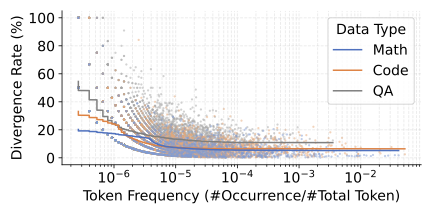
Token Frequency
Low-frequency tokens are more likely to be divergent in the training data, suggesting token rarity is a useful predictive signal.
Performance
Higher accuracy at lower inference cost.
R1-1.5B + R1-32B reaches 46% average accuracy with 5.6B average activated parameters, versus 43% for R1-14B and 50% for R1-32B.
*Cost is a decoding-cost proxy: output token count × average activated parameters (billions), including the SLM, router and weighted LLM usage. It is not measured latency.
On AIME with two A800-80GB GPUs, generation speed rises from 30.5 to 84.3 tokens/s (2.76×); mean request latency falls from 498 to 218 seconds (2.28×). See Table 3.
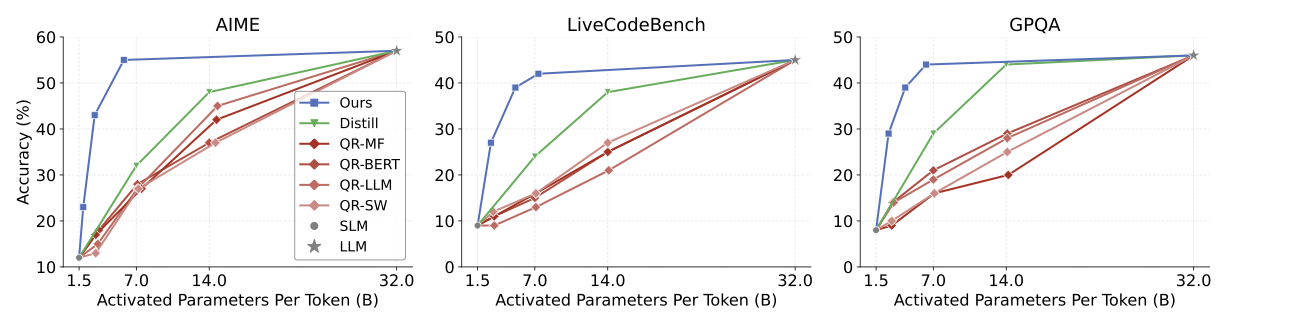
R2R consistently advances the Pareto frontier across AIME, GPQA, and LiveCodeBench benchmarks.
Detailed Benchmark Results
Table 2 setup: AIME 2024–2025, LiveCodeBench (Aug 2024–Jan 2025), and GPQA-Diamond; greedy decoding with a 32K output limit. The last column averages activated parameters across benchmarks.
| Method | AIME | LiveCodeBench | GPQA | Avg. Params |
|---|---|---|---|---|
| R1-1.5B (SLM) | 12% | 9% | 8% | 1.5B |
| R1-7B | 32% | 24% | 29% | 7.0B |
| R1-14B | 48% | 38% | 44% | 14.0B |
| R2R (Ours) | 55% | 39% | 44% | 5.6B |
| R1-32B (LLM) | 57% | 45% | 46% | 32.0B |
Routing Behavior Analysis
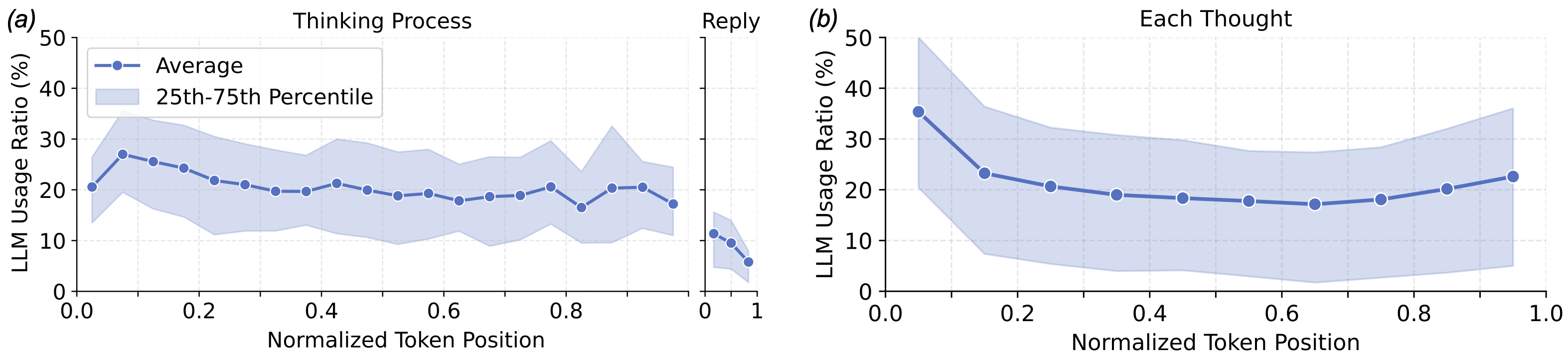
R2R naturally learns efficient routing patterns: fewer LLM calls during straightforward reply phases, and more at the beginning and end of each thought where reasoning direction is determined.
Citation
Cite our work.
If you find R2R useful for your research, please consider citing our paper.
@article{fu2025r2r,
          title={R2R: Efficiently Navigating Divergent Reasoning Paths with Small-Large Model Token Routing},
          author={Fu, Tianyu and Ge, Yi and You, Yichen and Liu, Enshu and Yuan, Zhihang and Dai, Guohao and Yan, Shengen and Yang, Huazhong and Wang, Yu},
          journal={arXiv preprint arXiv:2505.21600},
          year={2025}
        }